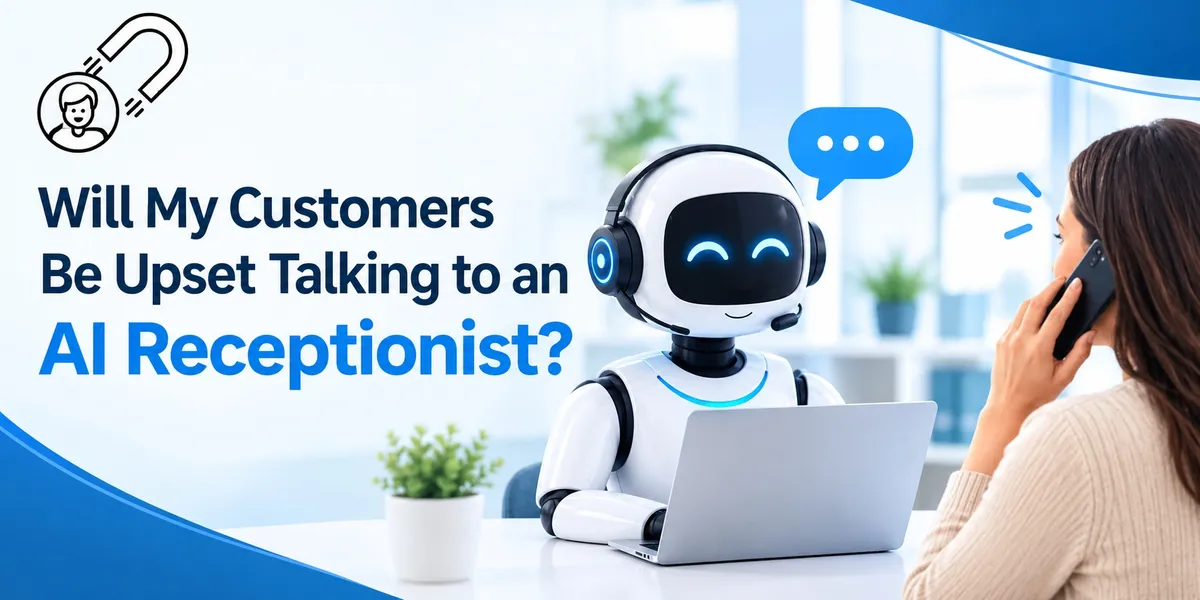
Will Customers Be Upset Talking to an AI Receptionist?
One of the biggest concerns business owners have regarding adopting AI is surprisingly counterintuitive: will it be as understanding as humans? This concern arises because customers want to feel heard, understood, and valued. Replacing a human assistant with an automated system may make interactions feel cold and impersonal. However, an AI receptionist does not necessarily involve taking away the human element from customer service.
When it comes to an AI solution, one of the concerns that many business owners have regarding its implementation is, "Will my customers actually like talking to an AI receptionist?” Many people assume that the only satisfactory answers can be provided by humans, but that is not the case. Read on to learn how an AI receptionist can be employed alongside human customer service representatives to satisfy both parties.
What Do Customers Want From a Receptionist?
The majority of individuals calling a business do so to receive answers, schedule appointments, ask questions, or request assistance. Think about what it’s like for a customer to call your business number after hours and be greeted by a voicemail message. They will either have to wait until the next day to get the information they need or leave a message and hope that someone hears their message and returns their call. An AI receptionist can answer calls 24/7, even when you aren’t available to take calls.
Speed May Often Matter More Than Humanity
Nowadays, people want businesses to be able to respond to their requests as soon as possible. If one misses a call, they risk losing an appointment, inquiry, or simply contacting someone with a question. With an AI receptionist, conversations can take place at once, and the information needed to answer an inquiry can be gathered or directed to the right person.
This can be especially helpful during busy times when your employees are focused on assisting customers, completing jobs, or other tasks. An AI Receptionist Can Help Customers By:
Answering calls 24/7
Answering frequently asked questions right away
Booking, rescheduling, or confirming appointments
Collecting customer and lead information
Following up with leads
Routing inquiries to the appropriate team member
Transferring calls when needed
What If a Customer Requests to Speak to a Human
Consumers are likely to prefer a human receptionist to an automated system, with up to 90% being inclined to speak to a person. According to a consumer study conducted by Metrigy, 80.1% prefer a human even when an AI system promises to resolve the issue equally well. Moreover, recent research conducted by Mews found that 75% of guests feel that good hospitality requires human staff, while 89% want to interact with AI only “behind the scenes,” doing the simple, repetitive, and time-consuming tasks.
Therefore, a virtual receptionist should be the first line of contact, not the barrier between your customers and your team. When the conversation requires human interaction, it should be possible to transfer the caller to a human representative. It can handle simple questions, appointments, and requests, and complex complaints or specialized inquiries can be easily escalated to your team.
Transparency Makes AI Feel More Comfortable
Companies should not try to trick their customers into thinking that they are talking to a real person. After all, whether customers will be upset talking to an AI receptionist often comes down to how transparent and helpful the interaction feels. A straightforward and professional introduction should be enough to set the direction for the call without giving away information that can be found elsewhere.
At the same time, the conversation should be relevant to what the company does and what the customers might need. Therefore, the virtual assistant needs to know information about the company and have answers to the customers' questions. AI should also be trained in the company's communication rules.
AI Doesn't Replace Your Whole Team
The point of having an AI call answering system is to take away monotonous parts of the job from employees. The AI can easily take care of simple communication, appointments, qualifying leads, and frequently asked questions. Then, the employees can spend more time focusing on the customers that need them.
This way, the company is relying on both human and artificial intelligence to better serve the customers and get leads. The AI can be used for basic communication, leaving the more complex communication to regular employees.
So, Will Customers Be Upset?
Some customers will probably prefer human to digital assistance, at least at first. But most customers likely care less about the medium and more about their issue being resolved fast.
An effective AI receptionist would be helpful to customers by being quick, accurate, efficient, and knowing when to alert a human representative. The issue is not people versus technology, but rather each doing what they do best.
The Bottom Line
Will Your Customers Be Disappointed Talking to an AI Receptionist? Probably not. Water treatment company customers usually ask the same questions: about the services, the appointment, the costs, maintenance, and specific water treatment inquiries. An AI receptionist can answer their most common questions, collect necessary information, and help to get their call routed to the right expert if needed.
By delegating standard procedures to an AI receptionist, you can ensure your customers are well taken care of and that your business’s human part is not overwhelmed by too many calls. A properly programmed AI will also be available 24/7 to assist your customers.
If you want to offer your customers a higher level of service while reducing the pressure on your team, ALSET Team can help you implement an AI receptionist that will take over some of the most frequent tasks and leave the complex water treatment cases to your employees.
