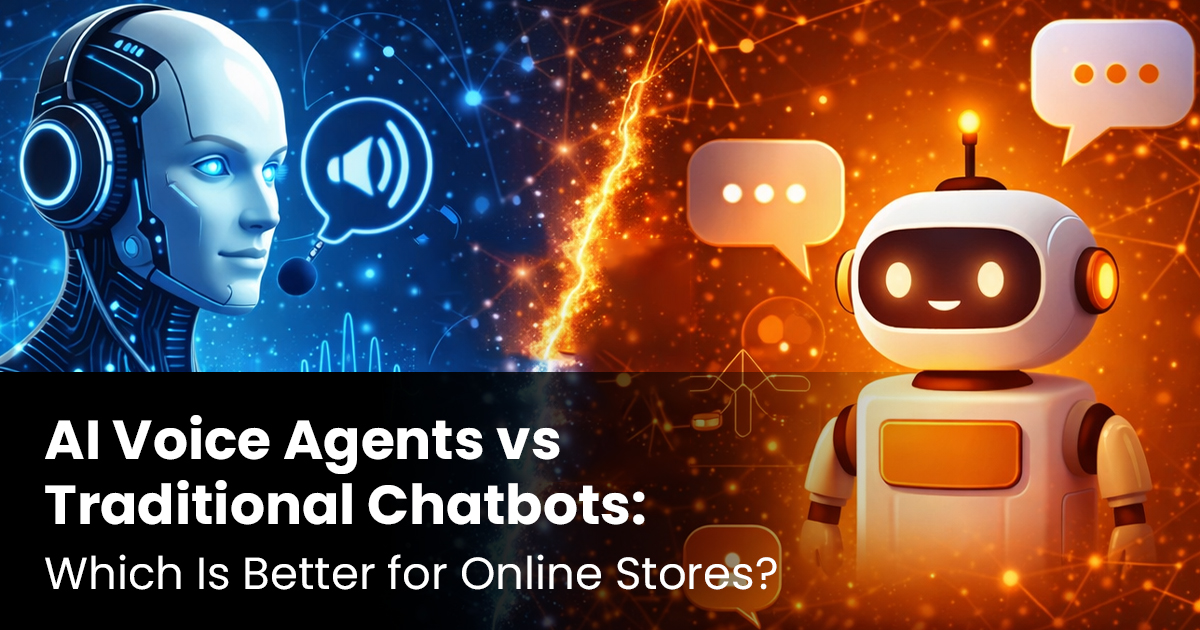
AI Voice Agents or Chatbots for Online Stores?
You often encounter issues such as order tracking delays, delivery mishaps, or return processing challenges during online shopping, where timely assistance becomes essential. On most trusted e-commerce sites, you will find interaction with an automated customer support tool. Two powerful solutions that offer instant and round-the-clock customer support are traditional chatbots and AI voice agents.
Both systems respond to customer queries; however, their ways to understand and respond to users are different. In this blog, we will explore core features of conversational AI agents and chatbots, helping you to decide which one to choose.
Traditional Chatbots: A Brief Overview
Chatbots are basically computer programs that are designed to allow users to have conversations automatically. Traditional chatbots answer questions based on decision trees or scripts. They follow predefined paths, so their responses are limited to what they are programmed to understand. While effective for simple inquiries, it directs more complex or unclear client concerns to human agents.
What Exactly are AI Voice Agents?
An AI Voice Agent is built with conversational technology designed to interact with users through natural spoken language. Using Natural Language Understanding and Advanced Speech Recognition System, it analyzes voice commands, processes queries, and responds just like a human.
People are allowed to interact hands-free by speaking naturally to complete tasks, get information, or receive support. This AI assistant system understands conversations, recognizes user intent, and provides smooth, personalized voice responses.
Conversational AI Agents vs Chatbots: Key Differences
Both AI agents and traditional chatbots have their own advantages in delivering customer support for an online store. By understanding their differences, you can choose the right option. This includes:
1. Intelligence
Traditional chatbots usually follow fixed scripts and respond only to specific keywords. As a result, it limits their ability to handle unexpected questions. On the other hand, a conversationalAI assistantunderstands language patterns, intent, and context. It responds more intelligently and manages more flexible, human-like conversations.
2. Conversation Flow
Chatbots follow a linear, menu-driven approach. In this chat system, predefined rules and responses are scripted, which works well for straightforward inquiries. On the other hand, AI voice agents use NLP to understand and interpret conversations in real time. They handle open-ended queries, give context-aware responses, and support natural back-and-forth discussions.
3. Scalability
Customer inquiries are getting more diverse as an online store expands. Rule-based chatbots require periodic manual updates to scripts. If your e-commerce store updates a return policy or feature, chatbot responses must be manually updated. As AI voice agents can adapt and learn from new conversations, they are more scalable than chatbots. It automatically improves its responses over time by continuously learning from customer interactions.
4. Customer Experience
Chatbots often feel mechanical because they rely on limited conversation flows. In contrast, AI-powered assistants provide smoother and more natural interactions. It understands user intent better and delivers quicker, more helpful results, which improve overall customer satisfaction.
End Note
In an e-commerce business, both AI voice agents and traditional chatbots support customers. But their effectiveness depends on user preference and the company’s needs. Businesses needing a quick, low-cost solution can use chatbots system, but an AI assistant system is better for personalized and smarter customer support.
If you run an online store and want to deliver smart customer support, then you should leverage innovative technology. The ALSET Team offer AI chat receptionist to make customer interactions smooth, fast, and automated. Book an appointment today and make your online store intelligent automation.
